
Electrical Coupling
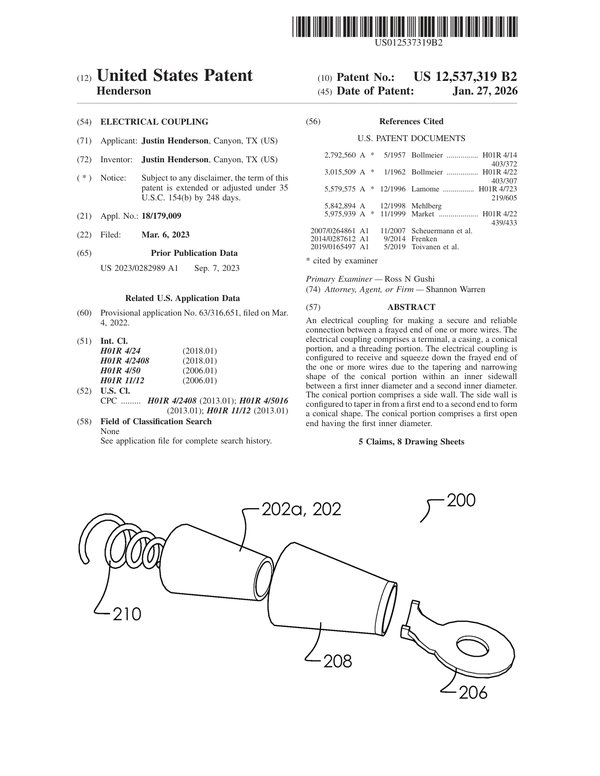
Patent Number: US 12537319 Grant Date: 2026-01-27 Filing Date: 2023-03-06
Overview
This patented electrical coupling, filed in March 2023 with provisional benefit reaching back to March 2022 and granted on January 27, 2026, captures a deceptively simple improvement on the conventional cable lug for terminating frayed wire ends. Developed by an inventor based in Canyon, TX and prosecuted with strong claim scope, the coupling combines a non-conductive casing with a conductive conical portion that tapers smoothly from a larger first inner diameter to a smaller second inner diameter, plus a threading portion helically bonded or press-fit into the conical inner sidewall. Frayed wire ends are inserted into the open end of the conical portion, where the narrowing taper and threading combine to squeeze and grip the strands tightly enough to transmit current cleanly to the terminal head — without the separate contact plate, nut, and clamping portion of a traditional cable lug. The enclosed second end of the conical portion fully caps and directly contacts the frayed wire ends, ensuring the connection is electrically continuous and mechanically protected. Claim coverage emphasizes a smooth, continuous tapering sidewall free of bends, steps, or segmented prongs — a meaningful structural distinction over earlier multi-step lug geometries.
Key Features
- Conical conductive bore that tapers between two inner diameters to squeeze down frayed wire strands
- Threading portion helically bonded or press-fit into the inner sidewall for additional grip
- Enclosed second end fully caps and directly contacts the frayed wire ends
- Non-conductive casing isolates the conductive coupling
- Smooth, continuous taper free of bends, steps, or segmented prongs
- Single-piece replacement for the contact-plate, nut, and clamping arrangement of conventional cable lugs
This invention offers electricians, OEM wire-harness builders, and electrical-product designers a smaller, structurally cleaner alternative to traditional cable lugs, suitable for the kind of frayed-wire termination that arises in repair, retrofit, and field-rebuild contexts.
Invention Details
Abstract: An electrical coupling for making a secure and reliable connection between a frayed end of one or more wires. The electrical coupling comprises a terminal, a casing, a conical portion, and a threading portion. The electrical coupling is configured to receive and squeeze down the frayed end of the one or more wires due to the tapering and narrowing shape of the conical portion within an inner sidewall between a first inner diameter and a second inner diameter. The conical portion comprises a side wall. The side wall is configured to taper in from a first end to a second end to form a conical shape. The conical portion comprises a first open end having the first inner diameter.
Summary of the Invention: Said electrical coupling for making a secure and reliable connection between said frayed end of said one or more wires. Said electrical coupling comprises said terminal, said casing, said conical portion, and said threading portion. Said electrical coupling is configured to receive and squeeze down said frayed end of said one or more wires due to the tapering and narrowing shape of said conical portion within said inner sidewall between said first inner diameter and said second inner diameter. Said conical portion comprises said side wall. Said side wall is configured to taper in from said first end to said second end to form a conical shape. Said conical portion comprises said first open end having said first inner diameter. Said conical portion is configured to receive said frayed end of said one or more wires into said first open end at said first end for electrical connection with said terminal. Said first end of said terminal is configured to connect with said second end of said conical portion. Said conical portion, said threading portion and said terminal are conductive and configured to transmit electricity from a portion of said conical portion to said terminal head. Said threading portion is configured to attach to said inner sidewall of said conical portion. Both said conical portion and said threading portion comprise a conductive material. Said threading portion is bonded into said conical portion. Said threading portion is loosely fit within said inner sidewall.
Patent Document
Related: Mechanical Engineering | Canyon, Texas | Shannon Warren, Patent Attorney