
SYSTEM AND METHOD FOR DETECTING MULTIPLE FRAGMENTS IN A TARGET MISSILE
Patent Number: US 10677758 Grant Date: 2020-06-09 Filing Date: 2017-10-10
Overview
This patented system equips a missile-like target with a gridless array of three or more sensors and a dedicated processing pipeline that separates and locates multiple, nearly simultaneous fragment impacts. Filed in October 2017 and granted in June 2020, the invention replaces fragile wire/optical grids with acoustic and RF-based impact modeling, digital interpolation, and a multi‑user detection framework to disentangle overlapping waveforms. Inventors based in Malabar, FL; Conroe, TX; and Spring, TX developed a detector that serially estimates individual impulse responses, subtracts identified signatures, and iterates to expose subsequent hits. The approach combines multilateration (triangulation) with convolutional‑coding ideas and Viterbi‑style decoding to map time‑ordered sensor detections to unique fragment identities and trajectories. The result is reliable impact counting, time‑of‑arrival tagging, and impact‑location confidence scoring even in high‑fragmentation “shrapnel kill” scenarios.
The drafting demonstrates technical depth in modeling impulse responses, handling multipath reflections, and bounding search complexity for real‑time operation, reflecting strong claims coverage around model‑based subtraction, detection statistics, and triangulation solutions.
Key Features
- Gridless acoustic/RF hit detection robust to multiple overlapping impacts
- Model‑based subtraction and interpolation for sub‑sample timing accuracy
- Convolutional‑style decoding to associate sensor detections with fragments
- Multilateration/triangulation with confidence metrics for impact localization
This innovation improves lethality assessment and trajectory reconstruction for missile testing and defensive systems, with clear applicability to aerospace defense testing and high‑fidelity impact monitoring in other critical structures.
Invention Details
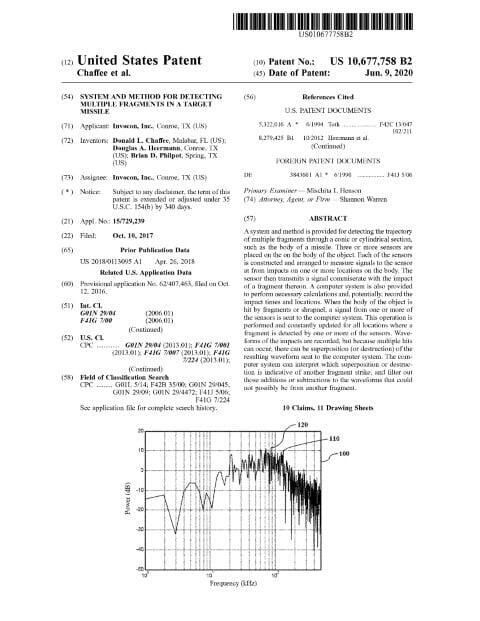
Abstract: A system and method is provided for detecting the trajectory of multiple fragments through a conic or cylindrical section, such as the body of a missile. Three or more sensors are placed on the on the body of the object. Each of the sensors is constructed and arranged to measure signals to the sensor at from impacts on one or more locations on the body. The sensor then transmits a signal commiserate with the impact of a fragment thereon. A computer system is also provided to perform necessary calculations and, potentially, record the impact times and locations. When the body of the object is hit by fragments or shrapnel, a signal from one or more of the sensors is sent to the computer system. This operation is performed and constantly updated for all locations where a fragment is detected by one or more of the sensors. Waveforms of the impacts are recorded, but because multiple hits can occur, there can be superposition (or destruction) of the resulting waveform sent to the computer system. The computer system can interpret which superposition or destruction is indicative of another fragment strike, and filter out those additions or subtractions to the waveforms that could not possibly be from another fragment.
Background: CROSS-REFERENCE TO RELATED APPLICATIONS (1) This application is a conversion of U.S. Provisional Patent Application No. 62/407,463 with the same title and from the same inventors as the present application, the aforesaid provisional application having been filed on Oct. 12, 2016, and which is incorporated herein by reference for all purposes. STATEMENT REGARDING FEDERALLY SPONSORED RESEARCH (2) This invention was not funded or sponsored by the federal government. BACKGROUND OF THE INVENTION 1. Field of the Invention (3) The present invention relates to anti-ballistic missiles. More specifically, the present invention relates to a method and system for detecting when fragments emanating from an anti-ballistic missile strikes a target missile in order to determine the effectiveness of the anti-ballistic missile. 2. Description of the Related Art (4) The Department of Defense (DOD) of the U.S. government has developed anti missile technology to protect the United States and allied interests against attack by different threat missiles. Threats may be ballistic in nature. That is, they are carried outside of the atmosphere by a rocket to extend the range of the weapon and subsequently re-enter the atmosphere and are guided to their intended target by external commands or internal guidance logic. Other threats may fly close to the earth to avoid radar and other short range defense systems via speed and maneuverability at “map of the earth” altitudes. (5) Defensive missiles have been designed as “hit-to-kill” weapons where a kinetic warhead (KW) on the killer (defensive) missile acquires the target threat and is guided to that target via external inputs as well as internal sensors and logic. This technique is adequate for many types of threat missiles. However, new threats may require a different approach to the “end game” kill scenario. This new technology is referred to as a “shrapnel kill” weapon. It is to missiles as a shot gun is to a goose hunter. The killing mechanism is not a simple one-piece kinetic warhead (KW); but, instead, it explodes into many shrapnel fragments when sensors indicate it is close enough to the target. The shrapnel fragments maintain the forward velocity of the killer missile as well as the additive acceleration and final velocity provided by the fragmenting explosive. This process is similar to a WW2 technology for hand grenades. (6) “Hit to Kill” weapons have been judged for their accuracy by lethality assessment systems that are installed and flown within the payloads of the “threat representative” target missiles. Historically, most impact and lethality assessment systems and methods for determining the impact point and damage propagation in a detection surface, such as ballistic missile intercepts, micrometeoroids and orbital debris (MMOD) or other shock events typically utilize wire or optical grids that form a mesh over the surface of the target missile. These grid systems report the initial hit point by monitoring the X/Y matrix of the grid and accurately determine the timing and sequence of broken conduction paths. This data is compiled and transmitted off of the target missile very quickly so as
Patent Document
Related: Computer Science & Software | Mechanical Engineering | Acoustics | Aerospace | Electrical Engineering | Security | Software And Electronics | Testing And Measurement | Conroe, Texas | Spring, Texas | Shannon Warren, Patent Attorney