
System and Method for Protecting a Machine Readable Card
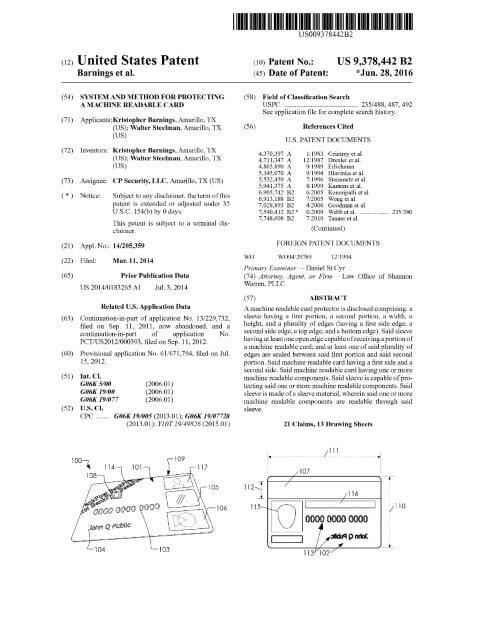
Patent Number: US 9378442 Grant Date: 2016-06-28 Filing Date: 2014-03-11
Overview
This patent describes a thoughtfully engineered protective sleeve that preserves machine-readable cards while preserving functionality. Filed on March 11, 2014 and granted on June 28, 2016, the application from inventors based in Amarillo, TX discloses a thin, non-opaque sleeve formed from polymer films (polyethylene or polyester) that is heat-sealed along selected edges and left open where needed to insert and remove a card. The design balances mechanical protection against friction and environmental wear with electronic accessibility: magnetic strips and electronic tags (RFID/NFC) remain readable through the sleeve, and an optional die-cut tag window covered by a conductive film enables tag signaling without removing the sleeve. Multiple manufacturing approaches are claimed, including RF, sonic, induction, and wire welding, with material thicknesses engineered to allow use in standard card readers while extending card service life. The drafting emphasizes manufacturability, printable graphics for branding, and non-adhesive retention so cards can be removed undamaged.
Key Features
- Heat-sealed polymer sleeve (1–3 mil range) preserving card readability
- Conductive film or conductive sleeve materials to permit electronic tag signals
- Multiple welding/assembly methods (RF, sonic, induction, wire weld)
- Graphic-printable, non-adhesive, removable protection
This patent exemplifies precise claim drafting and technical depth in both materials and manufacturing, offering a practical, industry-ready solution for card durability and secure electronic access across payments, ID, and access-control markets.
Invention Details
Abstract: A machine readable card protector is disclosed comprising: a sleeve having a first portion, a second portion, a width, a height, and a plurality of edges (having a first side edge, a second side edge, a top edge, and a bottom edge). Said sleeve having at least one open edge capable of receiving a portion of a machine readable card; and at least one of said plurality of edges are sealed between said first portion and said second portion. Said machine readable card having a first side and a second side. Said machine readable card having one or more machine readable components. Said sleeve is capable of protecting said one or more machine readable components. Said sleeve is made of a sleeve material, wherein said one or more machine readable components are readable through said sleeve.
Background: (1) This US patent application is a continuation in part of U.S. patent application Ser. No. 13/229,732 a nonprovisional application filed Sep. 11, 2011, of U.S. Patent Application No. 61/671,794 a provisional application filed Jul. 15, 2012, and PCT application PCT/US2012/000393 filed Sep. 11, 2012. BACKGROUND (1) Machine readable cards (such as a credit card, a government identification card, a driver’s license, a corporate identification card, a student identification card, or similar) are a well-known part of modern life. Many people are bound to carry around many of said machine readable cards for extended periods of every day. Their ubiquity has arisen on account of their convenience and many uses. Despite their usefulness, however, many components of said machine readable cards are fragile and prone to damage. For example, some cards comprise a magnetic strip. Magnetic strips are prone to damage due to repeated use due to friction wearing away critical portions of said magnetic strip. Likewise, holograms, electronic tags, thumbprints, and signatures are prone to harm due to repeated use and movement of said machine readable cards. Such use and movement can occur by the act of reading a magnetic strip with a card reader (sometimes called “swiping” a card). In another embodiment, merely carrying a card in one’s pocket can cause a frequent rubbing of one card on another and thereby ruining a portion of said card. Likewise, carrying multiple cards in a stack in a pocket can cause several cards to be harmed due to said frequent rubbing. (2) Solutions for protecting said machine readable cards are well-known but, ultimately, ineffective. For example, in one embodiment, banks will ship new cards to users in a card sized envelope. Some such envelopes comprise protective materials for keeping their contents safe from friction and other harmful elements. This approach, however, only works where a user is willing to keep track of the bank issued envelope. This goal often proves to be unachievable due to mishandling and misplacing said envelope. Further, where said card is held in said envelope, the combination of the two is unlikely to fit in a standard credit card slot in an envelope. Consequently, many banks have ceased to issue cards in said envelopes altogether. (3) Another approach is to laminate said machine readable cards to ensure that portions of said cards are protected from harm. This approach fails, however, because lamination often makes cards unreadable by card readers. For example, in one embodiment, a laminated credit card will be too thick for a credit card reader. In another embodiment, a magnetic strip cannot be read through said lamination. Further, lamination is not removable and repositionable in cases where the machine readable card must be replaced or altered. (4) This disclosure relates generally to a system and method for protecting a machine readable card. In one embodiment, said machine readable card comprises a credit card, but use of a credit card is illustrative only and not limiting. Examples of card protectors can be found in US
Patent Document
Related: Computer Science & Software | Mechanical Engineering | Electrical Engineering | Materials | Security | Software And Electronics | Amarillo, Texas | Shannon Warren, Patent Attorney