
Design Patent Application Process
A design patent protects the ornamental appearance of a functional article — its shape, contour, surface pattern, or overall visual design. The application process is faster and less expensive than a utility patent, but the drawings are critical. Here is how it works.
Process Flowchart
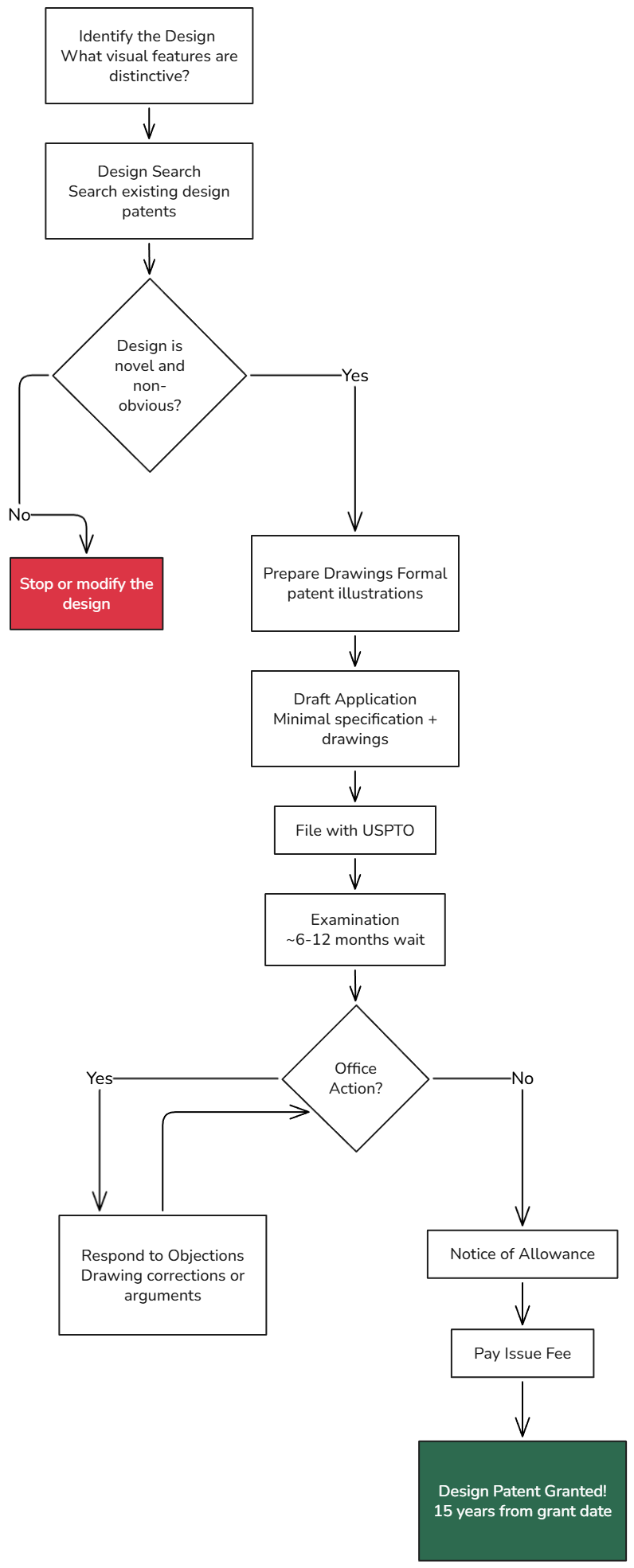
How Design Patents Differ from Utility Patents
In a utility patent, the written claims define your protection. In a design patent, the drawings are everything. The entire scope of your design patent is defined by what the drawings show. This makes the quality and completeness of your illustrations the single most important factor in your application.
A design patent has exactly one claim, which reads: “The ornamental design for a [article], as shown and described.”
For a side-by-side comparison, see Design Patent vs. Utility Patent.
Stage 1: Identify the Design
Before filing, you need to clearly identify which visual features of your product are distinctive and worth protecting. Consider:
- Shape and contour — the three-dimensional form of the article
- Surface ornamentation — patterns, textures, or decorative elements on the surface
- Overall visual impression — how the design looks as a whole, not just individual features
The design must be ornamental, not purely functional. If the shape of your product is dictated entirely by its function, it may not qualify for design patent protection.
Stage 2: Design Search
A design patent search reviews existing design patents and published applications to assess whether your design is novel. The search looks for:
- Prior art designs with similar visual characteristics
- Designs in the same or related product categories
- Published designs from any country that could anticipate your claimed design
The standard for design patent novelty focuses on visual similarity — would an ordinary observer consider the prior art design and your design to be substantially the same?
Stage 3: Prepare the Drawings
This is the most important step. Design patent drawings must:
Show every angle:
- Front view
- Rear view
- Left side view
- Right side view
- Top view
- Bottom view
- Perspective view (at least one)
Use correct line conventions:
- Solid lines show the claimed design — these define your protection
- Broken (dashed) lines show unclaimed features included for context (e.g., the body of a phone when you are only claiming the screen layout)
- Surface shading indicates three-dimensional contour
Meet USPTO formatting:
- Black ink on white paper (or rendered digitally to the same effect)
- Consistent scale across views
- Figure numbers for each view
- No dimensions, measurements, or descriptive text in the drawings
Tips for stronger design patents:
- Be strategic about what you show in solid vs. broken lines — solid lines define your scope
- Consider filing separate applications for design variations
- Show enough detail to distinguish your design from prior art, but not so much that you narrow your protection unnecessarily
Stage 4: Draft and File the Application
The written portion of a design patent application is minimal compared to a utility patent:
- Title — identifying the article of manufacture (e.g., “Ornamental Design for a Beverage Container”)
- Brief description of drawings — listing each figure and its view (e.g., “FIG. 1 is a front perspective view”)
- Single claim — “The ornamental design for a [article], as shown and described”
- Drawings — the heart of the application
The application is filed with the USPTO. Filing fees are lower than utility patents — approximately $200 for small entities as of 2026. See the USPTO Fee Schedule for current rates.
Stage 5: Examination
Design patent examination is generally faster and simpler than utility patent examination:
- Wait time: Approximately 6-12 months for a first office action (shorter than utility patents)
- Examiner’s search: The examiner searches for visually similar prior art designs
- Common objections: Drawing informalities (missing views, inconsistent line work, unclear shading) are the most frequent issues
- Substantive rejections: Less common than in utility patents, but the examiner may cite prior art designs that create a novelty or obviousness issue
Most design patent applications receive fewer office actions than utility patents, and the responses are typically less complex.
Stage 6: Grant
Once allowed and the issue fee is paid (~$350 for small entities), your design patent is granted. Key characteristics:
- Duration: 15 years from the date of grant
- No maintenance fees — unlike utility patents, design patents remain in force for their full term without additional payments
- Enforcement: Design patent infringement is evaluated under the “ordinary observer” test — would an ordinary person consider the accused product substantially similar to the patented design?
- Damages: Under 35 USC 289, a design patent owner can recover the infringer’s total profits from sales of articles bearing the infringing design
Timeline Summary
| Stage | Typical Duration |
|---|---|
| Design identification and search | 1 - 2 weeks |
| Drawing preparation | 2 - 4 weeks |
| Application drafting and filing | 1 - 2 weeks |
| USPTO examination queue | 6 - 12 months |
| Prosecution (if needed) | 1 - 3 months |
| Total: concept to grant | 12 - 18 months |
Frequently Asked Questions
Can I file a design patent and a utility patent for the same product? Yes, and it is often the strongest strategy. The utility patent covers function; the design patent covers appearance. See Design Patent vs. Utility Patent for guidance on when to file both.
Do I need a prototype for a design patent? No. You need detailed drawings showing the design from all required views. These can be based on CAD models, renderings, or hand-drawn concepts — as long as they meet USPTO formatting requirements.
How much does a design patent cost? Total costs typically range from $2,000 to $5,000 including attorney fees, drawings, and USPTO fees. See How Much Does a Patent Cost in Texas? for a full breakdown.
What if someone copies my design with minor changes? The “ordinary observer” test does not require identical copying. If the overall visual impression is substantially similar, minor differences do not avoid infringement.
Disclaimer: All fees and cost estimates on this page are for informational purposes only and do not constitute a binding quote. Actual costs vary based on the complexity of the invention, USPTO fee schedules, exchange rates, and other factors. Contact Shannon Warren for a specific estimate tailored to your situation.
Want to protect the visual design of your product? Contact Shannon Warren to discuss whether a design patent is right for your situation. Also see the Utility Patent Application Process if your invention has functional novelty.