
Types of Patents: Utility, Design, and Plant
The United States Patent and Trademark Office grants three distinct types of patents, each designed to protect a different aspect of an invention. Understanding which type applies to your invention is a critical first step in the patent process, because it affects the scope of your protection, the cost, the timeline, and the duration of your rights.
As a patent attorney with more than a decade of patent prosecution experience and an extensive portfolio of granted US patents, I help inventors make this determination every week. Here is a comprehensive guide to the three types of patents, how they work, and how to determine which one is right for your invention.
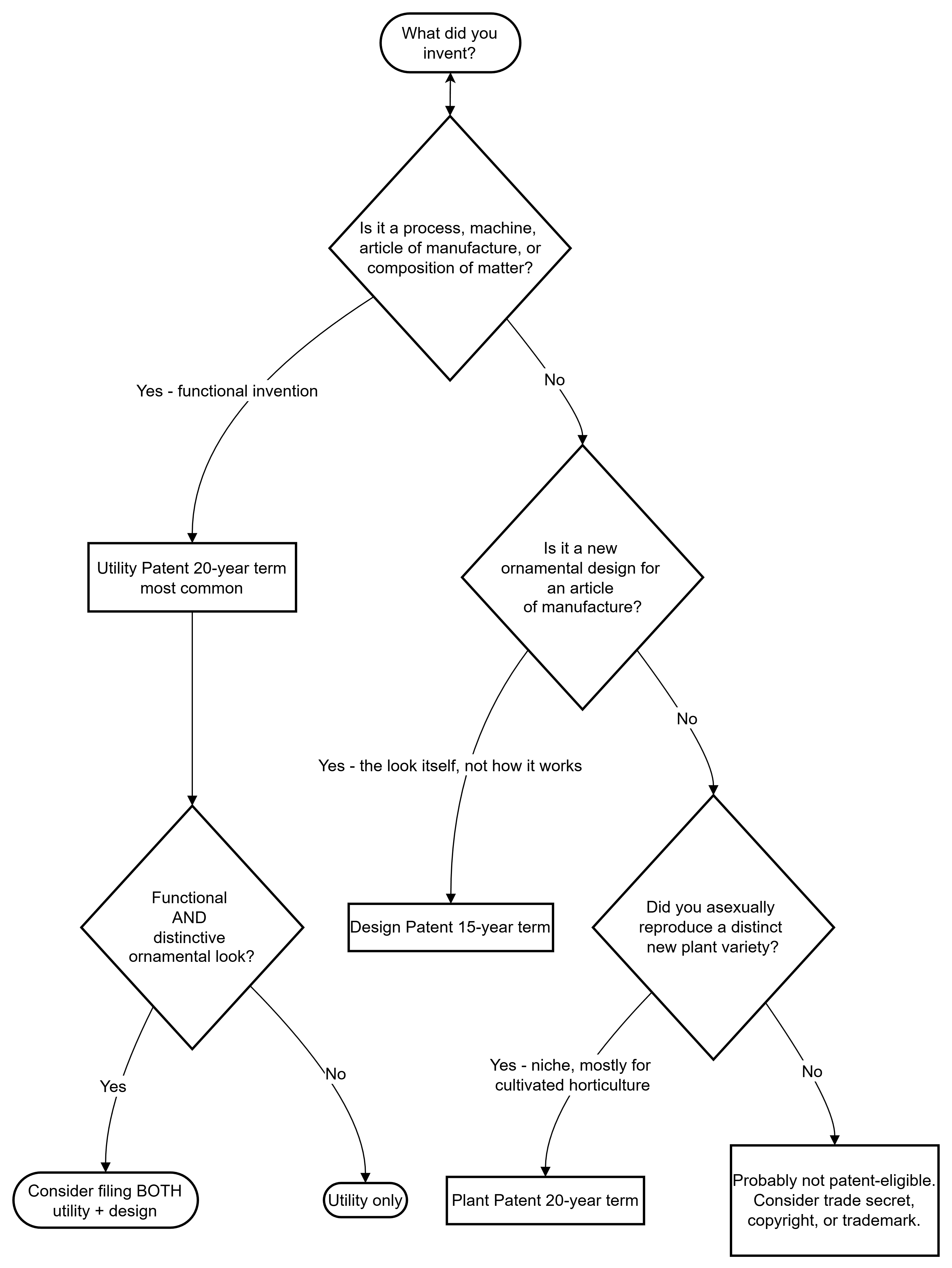
Decision Flowchart
Utility Patents
Utility patents are by far the most common type, accounting for roughly 90% of all patents issued by the USPTO. They protect how an invention works — its function, structure, composition, or process.
What Utility Patents Cover
A utility patent can protect any new and useful:
- Process: A method, procedure, or series of steps for achieving a specific result. Examples include manufacturing processes, software algorithms, chemical processes, and business methods (when tied to a specific technical implementation).
- Machine: A device or apparatus with moving parts or interacting components. This covers everything from simple hand tools to complex automated systems.
- Article of manufacture: A manufactured item without moving parts, such as a specialized container, a structural component, or a composite material panel.
- Composition of matter: A new chemical compound, mixture, alloy, or material. This category is common in pharmaceutical, chemical, and materials science patents.
Duration and Maintenance
Utility patents provide protection for 20 years from the filing date of the earliest non-provisional application. However, this term is contingent on paying maintenance fees to the USPTO at three intervals:
- 3.5 years after grant
- 7.5 years after grant
- 11.5 years after grant
Missing a maintenance fee deadline can result in the patent expiring early. See our guide on patent costs in Texas for specific fee amounts.
Utility Patent Examples from Our Portfolio
All patents in our Innovation Showcase are utility patents. Here are examples across different technology areas that illustrate the range of inventions that qualify:
Mechanical inventions:
- Rope Cleaner — An agricultural cleaning tool with a novel mechanical design for removing debris from ropes used in farming and ranching operations
- Saw Gin Stand Safety Assembly — Safety equipment for cotton ginning operations, protecting workers from a specific and dangerous industrial hazard
- Acoustic Isolation Booth — A structural assembly with specific acoustic properties for construction and medical environments
Electromechanical and automation inventions:
- Bandsaw Automated Portioning Saw System — A robotic automation system that combines mechanical cutting components with visual processing for precise food portioning
- Automatic Gin Blade Trainer — An agricultural automation device that uses automated processes to maintain and train gin blades
Software-integrated inventions:
- Gun Lock — A consumer safety locking mechanism with software components for access control and monitoring
- Tool Safety System — A safety system that integrates digital tracking technology with physical safety mechanisms
Energy and process inventions:
- Hydrogen Hybrid Cycle System — A novel energy technology process for hydrogen-based power generation
- Oilfield Chemical Injection System — An oil and gas process invention covering both the equipment and the method of injecting chemicals in oilfield operations
Medical device inventions:
- Endoscope Instrumentation Drive System — A precision medical device drive mechanism for endoscopic procedures
The Utility Patent Application Process
Utility patent applications are the most detailed and expensive type to prepare, but they also provide the broadest and most valuable protection. The application includes a full specification, formal drawings, and a set of claims that define the scope of protection. The USPTO examines the application for novelty, non-obviousness, and utility before granting the patent.
For a complete walkthrough of the process, see our Patent Process Overview or the detailed Utility Patent Application Process guide with flowchart. If you are considering a provisional filing first, see Provisional Patent Application.
Design Patents
Design patents protect the ornamental appearance of a functional item — not how it works, but how it looks. If your innovation is a unique visual design applied to a product, a design patent may be the right choice.
What Design Patents Cover
A design patent protects the specific visual characteristics of an article of manufacture, including:
- Shape and configuration: The three-dimensional form of a product
- Surface ornamentation: Patterns, textures, or decorative elements applied to the surface
- Overall visual impression: The combination of shape, proportion, and surface treatment that gives the product its distinctive look
Design patents do not protect functional features. If the shape or appearance of your product is dictated primarily by its function (for example, a gear tooth profile shaped for optimal meshing), that aspect is not eligible for design patent protection. It may, however, be eligible for a utility patent. For a detailed comparison, see Design Patent vs. Utility Patent and the Design Patent Application Process guide.
Examples of Design Patents
While our practice focuses on utility patents, design patents are common in industries like:
- Consumer electronics: The distinctive shape of a smartphone, the layout of a user interface, or the design of a smartwatch
- Furniture: A unique chair shape, table leg design, or shelving configuration
- Automotive: Distinctive vehicle body shapes, wheel designs, or dashboard layouts
- Fashion accessories: Handbag shapes, jewelry designs, or eyewear frames
- Packaging: Unique bottle shapes, box configurations, or container designs
The Apple vs. Samsung case, one of the most well-known patent disputes of the past decade, centered heavily on design patents covering the shape and appearance of smartphones and tablets.
Duration and Cost
Design patents last 15 years from the grant date and do not require maintenance fees, making them simpler and less expensive to maintain than utility patents.
The application process is also less expensive. Design patent applications include drawings (which are the most critical component, since the drawings define the scope of protection) and a single claim. They do not require the detailed specification that utility patents demand.
Typical costs for a design patent range from $3,000 to $6,000 total, including attorney fees and USPTO filing and issue fees.
Limitations of Design Patents
Design patents are narrower than utility patents. A competitor can often design around a design patent by making modest changes to the appearance while keeping the same functionality. For this reason, design patents work best as a complement to utility patents rather than a substitute.
Plant Patents
Plant patents protect new and distinct varieties of plants that have been asexually reproduced. This is a specialized type of patent with limited applicability.
What Plant Patents Cover
A plant patent covers a new variety of plant that is:
- New and distinct: The plant must be different from known varieties in at least one significant characteristic (such as color, growth habit, disease resistance, or fruit flavor)
- Asexually reproduced: The plant must have been reproduced through means other than seeds — such as cuttings, grafting, budding, or tissue culture. This ensures that the new variety is genetically identical to the original and maintains its distinctive characteristics.
What Plant Patents Do Not Cover
- Tuber-propagated plants (like potatoes) are specifically excluded from plant patent protection, though they may be protectable under the Plant Variety Protection Act administered by the USDA.
- Plants found in the wild are not patentable unless the discoverer asexually reproduces them and demonstrates that they are a new and distinct variety.
- Sexually reproduced plants (grown from seeds) are generally protected under the Plant Variety Protection Act rather than through plant patents.
Duration
Plant patents last 20 years from the filing date, the same term as utility patents.
Relevance to Texas Inventors
Texas has a significant agricultural sector, and plant patents can be relevant to nurseries, agricultural research stations, and plant breeders developing new crop varieties or ornamental plants. However, plant patents represent a very small fraction of all patents issued (typically fewer than 1,500 per year compared to over 300,000 utility patents).
Given our practice areas in Agriculture and the strong agricultural economy across Texas, I occasionally field questions about plant patents from clients who are also working on agricultural equipment inventions like the Rope Cleaner or Automatic Gin Blade Trainer.
Choosing the Right Type of Patent
Decision Framework
Ask yourself these questions to determine which patent type fits your invention:
Is your innovation about how something works (its function, process, or composition)? You need a utility patent. This covers the vast majority of inventions across all industries.
Is your innovation about how something looks (its appearance, shape, or ornamentation)? You need a design patent. This is appropriate when the visual design is the innovative element.
Did you develop a new plant variety through asexual reproduction? You need a plant patent.
Does your invention have both a novel function and a distinctive appearance? You may benefit from both a utility patent and a design patent. This dual approach provides the broadest protection — the utility patent covers the function while the design patent protects the appearance. Many successful product companies use both types to build a comprehensive IP portfolio.
You think your invention is purely beautiful but suspect a utility patent might be hiding inside it? This is common with furniture, household tools, fashion accessories, and other objects designed to look right. The functional invention is often present but un-articulated. See From Beautiful to Functional: Finding the Utility Patent in Your Design — a brainstorm worksheet that walks through the questions to surface the hidden utility before you commit to one path or the other.
Comparison at a Glance
| Feature | Utility Patent | Design Patent | Plant Patent |
|---|---|---|---|
| Protects | Function, process, structure | Ornamental appearance | New plant variety |
| Duration | 20 years from filing | 15 years from grant | 20 years from filing |
| Maintenance fees | Required (3 payments) | None | None |
| Typical cost | $10,000 - $30,000+ | $3,000 - $6,000 | $5,000 - $10,000 |
| Examination time | 2 - 3 years | 1 - 2 years | 1 - 2 years |
| Scope of protection | Broadest | Narrow (appearance only) | Specific variety only |
When to Consider Multiple Patent Types
In some cases, a comprehensive IP strategy involves filing multiple types of patents on the same product. For example:
- A utility patent on the functional mechanism of a new kitchen appliance, plus a design patent on its distinctive housing shape
- A utility patent on the electronic control system of a medical device, plus a design patent on its user interface layout
- A utility patent on the manufacturing process for a new material, plus design patents on products made from that material
Your patent attorney can advise on which combination provides the best protection for your specific situation and budget.
Beyond Patents: Other IP Protection
Patents are not the only way to protect intellectual property. Depending on your situation, you might also consider:
- Trade secrets: Keeping your invention confidential rather than patenting it — appropriate when the invention cannot be reverse-engineered from the final product. See our guide on Patent vs. Trade Secret for help deciding which approach fits your situation.
- Trademarks: Protecting your brand name, logo, or product name
- Copyrights: Protecting creative works, including software code, technical documentation, and artistic designs
- Utility models: Some foreign countries offer utility models (sometimes called “petty patents”) that provide shorter-term protection with faster and less expensive prosecution. See International Patent Protection for more on filing outside the US.
Whichever path you choose, timing matters. If you publicly use or sell your invention, you may have a limited window to file. Read about the one-year rule and patent filing deadlines before making any public disclosures.
A patent attorney can help you evaluate the full range of IP protection strategies available for your specific situation. For cost guidance, see How Much Does a Patent Cost in Texas?
Frequently Asked Questions
Which type of patent is most common? Utility patents account for approximately 90% of all patents granted by the USPTO. As of 2026, the USPTO issues over 300,000 utility patents per year, compared to roughly 40,000 design patents and fewer than 1,500 plant patents.
Can I convert a design patent application to a utility patent application? No, you cannot convert between patent types. However, you can file both a utility and a design patent application covering different aspects of the same product. If you are unsure which type to pursue, discuss both options with your attorney early in the process.
Do design patents provide weaker protection than utility patents? Design patents provide narrower protection, covering only the specific ornamental appearance shown in the drawings. Competitors can avoid design patents by making changes to the appearance. However, design patents are less expensive to obtain, do not require maintenance fees, and are relatively easy to enforce when infringement is clear. They are most effective when used in combination with utility patents.
How do I know if my invention qualifies for a utility patent? Your invention must be novel (new), non-obvious (not a trivial combination of existing ideas), and useful (it has a practical application). A prior art search and patentability assessment by a qualified patent attorney is the best way to evaluate whether your invention meets these requirements.
Can software be patented? Yes, software-related inventions can be protected by utility patents when they are claimed as a specific technical solution rather than an abstract idea. The legal standards for software patents have evolved significantly in recent years, and experience in this area matters. With a Computer Engineering background and deep experience in Computer Science & Software patents, Shannon Warren helps software inventors navigate these requirements.
What happens if someone infringes my patent? As the patent holder, you have the right to enforce your patent through the federal court system. Patent infringement lawsuits can result in injunctions (court orders stopping the infringer), monetary damages, and in some cases attorney fees. Many infringement situations are resolved through licensing negotiations rather than litigation.
Disclaimer: All fees and cost estimates on this page are for informational purposes only and do not constitute a binding quote. Actual costs vary based on the complexity of the invention, USPTO fee schedules, exchange rates, and other factors. Contact Shannon Warren for a specific estimate tailored to your situation.
Not sure which type of patent is right for your invention? Shannon Warren has spent more than a decade helping Texas inventors select the right patent strategy. With a Computer Engineering degree and experience across Mechanical Engineering, Computer Science, Oil & Gas, Agriculture, Medical Devices, Energy, and Robotics & Automation, he can evaluate your invention and recommend the approach that provides the strongest protection for your investment. Contact Shannon Warren for a consultation.