
Design Patent vs. Utility Patent — Which Do You Need?
When inventors think about patents, they usually think about utility patents — the type that protects how an invention works. But there is another option that many inventors overlook: design patents, which protect how a product looks. Understanding the difference between these two types of protection, and knowing when to use each, can significantly strengthen your intellectual property position.
This guide explains what design patents and utility patents each cover, how they differ in cost, duration, and scope, and when it makes sense to file one, the other, or both.
What a Utility Patent Covers
A utility patent protects the functional aspects of an invention — how it works, what it does, and how it is made. This is by far the most common type of patent, covering:
- Processes — a method of doing something (manufacturing a product, processing data, treating a medical condition)
- Machines — devices with moving parts or functional components
- Articles of manufacture — physical items that are made (tools, containers, structures)
- Compositions of matter — chemical compounds, material formulations, pharmaceutical compositions
Duration: 20 years from the filing date of the non-provisional application.
Requirements: The invention must be novel, non-obvious, and useful.
What the claims look like: Utility patent claims are written in words and describe the functional elements and their relationships. For example: “A cleaning device comprising a housing, a rotating brush assembly mounted within the housing, and a motor connected to the brush assembly…”
Every patent in our Innovation Showcase is a utility patent. From the Rope Cleaner to the Endoscope Instrumentation Drive System, these patents protect the functional innovations that make each invention work.
What a Design Patent Covers
A design patent protects the ornamental appearance of a functional article — its visual design, shape, surface ornamentation, or overall look. A design patent does not protect how something works, only how it looks.
Duration: 15 years from the date of grant (no maintenance fees required).
Requirements: The design must be novel, non-obvious (in terms of appearance), and ornamental (not purely functional).
What the claims look like: A design patent has a single claim that simply states: “The ornamental design for a mouse trap, as shown and described.” The protection is defined entirely by the drawings — detailed illustrations showing the design from multiple views.
Examples of Design Patents
- The distinctive shape of a smartphone
- The ornamental pattern on a shoe sole
- The unique contour of a bottle
- The visual design of a user interface icon or screen layout
- The decorative shape of a piece of furniture
What Design Patents Do NOT Cover
Design patents do not protect:
- Features that are purely functional (the shape of a wrench head, for instance, if that shape is dictated entirely by its function)
- The underlying mechanism or process
- The concept or idea behind the design
- Color alone (though color can be part of a design patent in specific contexts)
Key Differences at a Glance
| Factor | Utility Patent | Design Patent |
|---|---|---|
| Protects | How it works | How it looks |
| Duration | 20 years from filing | 15 years from grant |
| Claims | Written functional descriptions | Drawings only |
| Number of claims | Typically 10-20+ | Exactly 1 |
| Prosecution time | 2-3 years average | 12-18 months average |
| Filing cost (attorney + USPTO) | $8,000 - $15,000+ | $2,000 - $5,000 |
| Maintenance fees | Yes (3.5, 7.5, 11.5 years) | None |
| Examination rigor | High | Moderate |
| Scope of protection | Broad (covers functional equivalents) | Narrow (limited to visual similarity) |
Cost Comparison in Detail
Design patents are substantially less expensive than utility patents at every stage:
Filing and Prosecution
| Cost Component | Utility Patent | Design Patent |
|---|---|---|
| Attorney drafting fees | $5,000 - $12,000 | $1,500 - $3,000 |
| USPTO filing expenses (small entity) | ~$800 | ~$400 |
| Office action responses | $1,000 - $3,000 each | Less common; $500 - $1,500 |
| Issue fee (small entity) | ~$1,000 | ~$350 |
For the most current fee amounts, see the USPTO Fee Schedule.
Lifetime Costs
| Cost Component | Utility Patent | Design Patent |
|---|---|---|
| 3.5-year maintenance (small entity) | ~$800 | None |
| 7.5-year maintenance (small entity) | ~$1,800 | None |
| 11.5-year maintenance (small entity) | ~$3,700 | None |
| Total lifetime USPTO fees | ~$8,000+ | ~$1,000 |
The absence of maintenance fees makes design patents particularly attractive for cost-conscious inventors. For a complete cost breakdown, see our patent cost guide.
Which Type Should You File?
The flowchart below walks you through the decision:
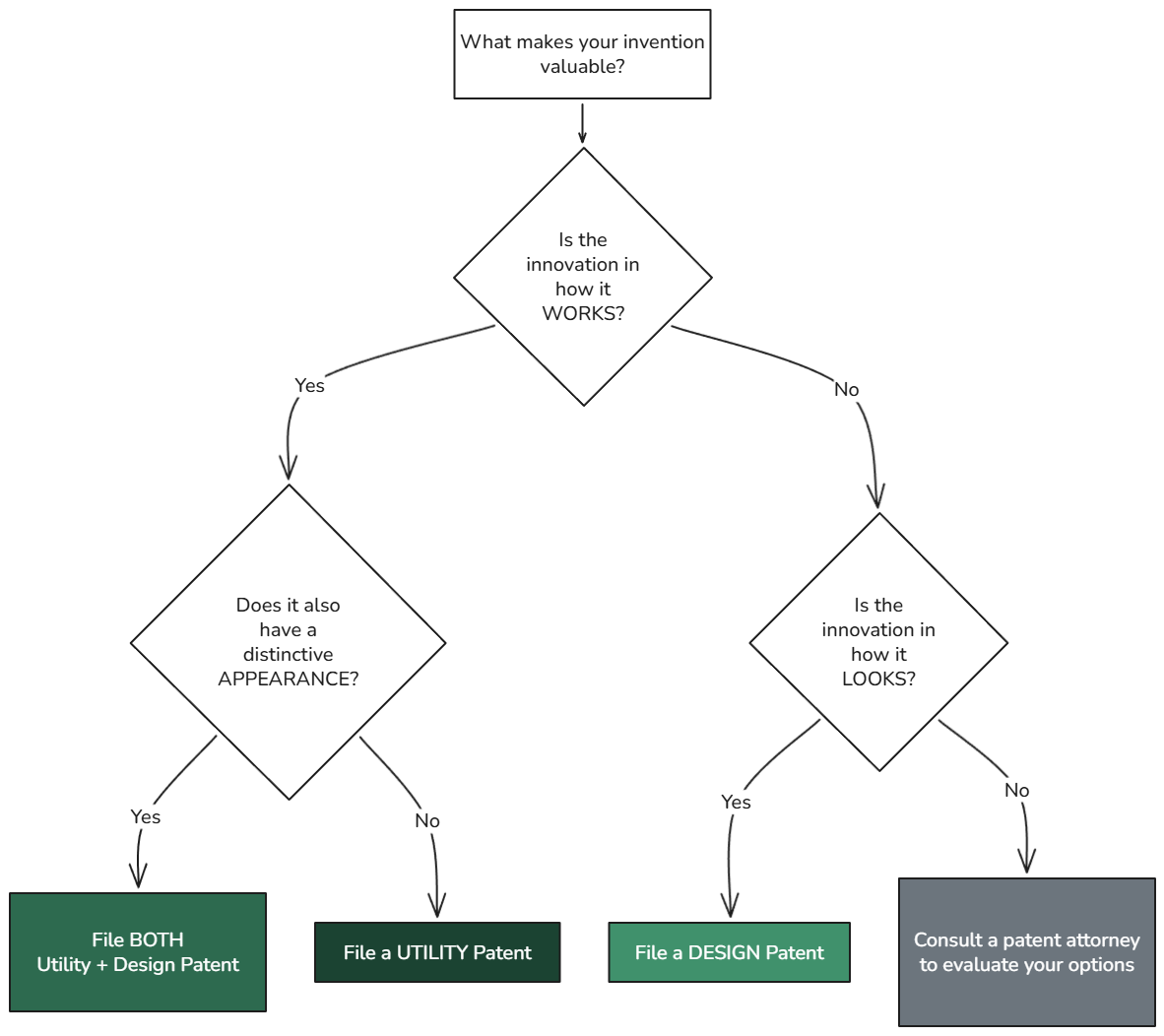
When to File a Utility Patent
- Your innovation is in how the product works. The competitive advantage comes from the function, mechanism, process, or method — not the appearance.
- You want broad protection. Utility claims cover functional equivalents, so competitors cannot avoid infringement with minor design changes.
- Your product’s appearance may change. A utility patent protects the function regardless of cosmetic updates.
- You want to license the technology. Utility patents cover the functional concept, which can be implemented in many product designs.
When to File a Design Patent
- The product’s appearance is its primary differentiator. Customers choose your product because of how it looks.
- You need quick, affordable protection. Design patents are granted in 12-18 months at a fraction of utility patent cost.
- The functional aspects are not novel. How it works is conventional, but how it looks is distinctive.
- You want to prevent knockoffs. Design patents stop competitors from copying your visual design.
Before you commit: if you suspect there is also a utility patent hiding inside your design but you have not been able to articulate it yet, work through the brainstorm in From Beautiful to Functional: Finding the Utility Patent in Your Design. The worksheet surfaces the “solved problem” that anchors a utility claim — or confirms that design-patent protection is the right path on its own.
When to File Both
The strongest strategy is often to file both:
- The product has functional novelty AND distinctive appearance. The utility patent covers how it works; the design patent covers how it looks.
- You want layered protection. If a competitor designs around one patent, they may still infringe the other.
- The design has brand value. A design patent protects brand recognition at the product level, complementing trademark protection.
Consider a new medical device with both a novel internal mechanism and a distinctive ergonomic housing. A utility patent prevents competitors from making devices that work the same way. A design patent prevents them from making devices that look the same way. Together, they provide comprehensive protection.
The Application Process
Each type of patent follows a distinct application process with its own timeline, requirements, and strategy considerations. We have created dedicated guides for each:
-
Utility Patent Application Process — Detailed walkthrough of the utility patent process from disclosure through grant, including a step-by-step flowchart, office action strategies, and timeline expectations. (2-3 years typical)
-
Design Patent Application Process — How design patent applications work, drawing requirements, examination process, and a step-by-step flowchart. (12-18 months typical)
For a general overview covering both types, see the Patent Process Overview.
Frequently Asked Questions
Can I file a design patent and a utility patent for the same product? Absolutely. This is common and often recommended. The utility patent covers how it works; the design patent covers how it looks. They are separate applications with separate fees, but they can be filed simultaneously or at different times.
Do design patents require maintenance fees? No. Once a design patent is granted, it remains in force for 15 years from the grant date with no additional fees. This is a significant cost advantage over utility patents, which require maintenance fee payments at 3.5, 7.5, and 11.5 years.
How do I know if my product’s appearance is distinctive enough for a design patent? The design must be novel and non-obvious compared to existing designs in the same field. If the appearance of your product is noticeably different from what is already on the market — in shape, contour, surface pattern, or overall visual impression — it may qualify. A patent attorney can conduct a design patent search to evaluate this.
What happens if someone makes a product that looks similar but not identical to my design patent? Design patent infringement is evaluated based on the “ordinary observer” test — would an ordinary observer, familiar with prior art designs, find the accused design substantially similar to the patented design? Minor differences do not avoid infringement if the overall visual impression is the same.
Are design patents enforceable? Yes. Design patents carry the same legal weight as utility patents. In fact, design patent damages can be particularly powerful — under 35 USC 289, a design patent owner can recover the infringer’s total profits from sales of articles bearing the infringing design. The Supreme Court addressed the scope of this remedy in Samsung v. Apple (2016), a case that centered on smartphone design patents.
Disclaimer: All fees and cost estimates on this page are for informational purposes only and do not constitute a binding quote. Actual costs vary based on the complexity of the invention, USPTO fee schedules, exchange rates, and other factors. Contact Shannon Warren for a specific estimate tailored to your situation.
Not sure which type of patent you need? Contact Shannon Warren for a consultation. With extensive patent prosecution experience and a proven portfolio of US patents, I help inventors determine the right protection strategy and draft applications that provide meaningful, enforceable coverage.