International Patent Protection — Filing Patents Outside the US
A US patent protects your invention only in the United States. If you manufacture, sell, or compete in international markets, a US patent alone leaves your invention unprotected everywhere else. Competitors in Europe, Asia, or any other region can freely copy your invention without consequence — unless you have patent protection in those countries as well.
International patent filing is a significant investment, and it is not the right choice for every inventor. But for those whose technology has global market potential, understanding the process, costs, and timelines is essential to making informed decisions. This guide covers the two main pathways for international patent protection, the costs involved, and when it makes strategic sense for Texas inventors.
The Basics: There Is No “International Patent”
The first thing to understand is that there is no single patent that covers the entire world. Each country has its own patent office, its own patent laws, and its own examination process. To obtain patent protection in a specific country, you must file an application in that country (or through a regional system that covers multiple countries, like the European Patent Office).
This means international patent protection involves multiple applications, multiple sets of fees, and often multiple languages. The process is managed through international treaties that streamline filing and provide strategic flexibility, but it is inherently more complex and expensive than domestic-only patent protection.
Pathway 1: The Paris Convention (Direct Filing)
The Paris Convention for the Protection of Industrial Property, established in 1883, is the oldest and most fundamental international patent treaty. It provides a simple but important right: priority.
How It Works
If you file a patent application in one member country (such as the US), you have 12 months from that filing date to file in any other member country and claim the benefit of your original filing date. This is called convention priority.
For example, if you file a US patent application on January 15, 2026, you have until January 15, 2027 to file in any Paris Convention member country — and those foreign applications will be treated as if they were filed on January 15, 2026, for purposes of determining novelty and prior art.
When to Use Direct Filing
Direct filing under the Paris Convention makes sense when:
- You know exactly which countries you need protection in
- You need protection in only one or two countries
- You want to move quickly in specific key markets
- The cost of a PCT application (discussed below) is not justified by your filing strategy
Limitations
The 12-month deadline is firm. If you miss it, you lose the ability to claim priority from your US filing date, and any public disclosures made after your US filing date will count as prior art against your foreign applications.
Direct filing requires you to make country-specific decisions within 12 months of your US filing — often before you have enough market data to know which countries matter most. This is why many inventors prefer the PCT pathway.
Pathway 2: The Patent Cooperation Treaty (PCT)
The PCT, administered by the World Intellectual Property Organization (WIPO), is the most common pathway for international patent filing. It does not result in an international patent itself, but it provides a streamlined process for seeking patent protection in over 150 member countries.
How the PCT Process Works
Phase 1: International Filing (Month 0-12)
You file a single PCT application, typically within 12 months of your US filing date (claiming Paris Convention priority). The PCT application is filed through the USPTO as the receiving office or directly with WIPO.
Phase 2: International Search (Months 3-6)
An international searching authority (usually the USPTO, EPO, or another major patent office) conducts a prior art search and issues an International Search Report (ISR) and Written Opinion. This report tells you how your claims stack up against the prior art in the view of the searching authority.
Phase 3: Optional International Preliminary Examination (Months 6-22)
You can request an International Preliminary Examination Report (IPER), which provides a more detailed assessment of patentability. This step is optional but can help you evaluate the strength of your application before investing in national phase filings.
Phase 4: Publication (Month 18)
Your PCT application is published by WIPO 18 months after the earliest priority date.
Phase 5: National Phase Entry (Month 30-31)
This is the critical decision point. By month 30 (31 in some countries) from the earliest priority date, you must “enter the national phase” in each country where you want patent protection. This means filing a national application, paying national fees, and in most countries, providing a translation of your application into the local language.
Once you enter the national phase, each country examines your application independently according to its own patent laws.
Key Advantage: Time
The PCT’s primary advantage is time. Instead of making country-specific filing decisions within 12 months of your US filing (as required under direct Paris Convention filing), the PCT gives you 30 months from your priority date. That extra 18 months is valuable time to:
- Generate revenue and evaluate market demand
- Secure investment or partnership commitments
- Receive the International Search Report and evaluate your application’s strength
- Make more informed decisions about which countries to enter
Key Advantage: Single Filing
Instead of preparing and filing separate applications in each country within 12 months, you file a single PCT application in one language with one set of fees. The national phase filings come later, and by that point, you have the benefit of the international search results to guide your strategy.
Cost Considerations
International patent protection is expensive. Here is a realistic breakdown of costs at each stage:
PCT Application Filing Costs
| Component | Approximate Cost |
|---|---|
| International filing fee | $1,500 - $3,000 |
| Search fee (depends on searching authority) | $1,000 - $2,500 |
| Attorney fees for PCT filing | $2,000 - $5,000 |
| Total PCT filing | $4,500 - $10,500 |
Small entity and micro entity discounts are available for the international filing fee.
National Phase Entry Costs (Per Country)
This is where the costs multiply. Each country you enter has its own fees:
| Component | Approximate Cost Per Country |
|---|---|
| National office filing fees | $500 - $3,000 |
| Translation costs | $2,000 - $8,000 (varies dramatically by language and application length) |
| Local agent/attorney fees | $1,000 - $5,000 |
| Total per country | $3,500 - $16,000 |
Total Cost Examples
For a hypothetical PCT application entering the national phase in five countries:
| Scenario | Total Estimated Cost |
|---|---|
| PCT filing + 3 countries (e.g., Europe, China, Japan) | $20,000 - $60,000 |
| PCT filing + 5 countries (e.g., Europe, China, Japan, Korea, Canada) | $30,000 - $90,000 |
| PCT filing + 10 countries | $60,000 - $160,000+ |
These estimates include filing through grant and assume typical prosecution costs. Costs vary significantly depending on the countries selected, the complexity of the technology, and the length of prosecution.
Managing International Patent Costs
Several strategies help manage the cost:
Be selective about countries. You do not need protection everywhere. Focus on countries where you manufacture, where you sell, and where your competitors operate. Three to five countries is a common range for small to mid-size businesses.
Use the PCT strategically. The PCT lets you defer the most expensive decisions (national phase entry) until month 30, when you have more information about market potential and patent strength.
Consider regional systems. The European Patent Office (EPO) allows you to file a single application that, once granted, can be validated in multiple European countries. This is more cost-effective than filing individually in each European country.
Budget for translations early. Translation costs are often the largest single expense in international filing. Get estimates early and factor them into your budget.
Key Markets for Texas Inventors
The countries that matter most depend on your specific technology and market, but several come up frequently for Texas-based inventors:
European Patent Office (EPO)
The EPO covers 39 member states through a single examination. Once granted, the European patent is validated in specific member states where you want protection. Key markets within Europe include Germany (the largest European economy), the UK (filed separately since Brexit), and France.
China
China has the world’s second-largest economy and a rapidly growing patent system. For inventors in manufacturing, energy, and technology, China is often a critical market. The China National Intellectual Property Administration (CNIPA) examines applications in Chinese, so translation costs are significant.
Japan
Japan is a major market for technology, automotive, medical devices, and advanced manufacturing. The Japan Patent Office (JPO) is known for thorough examination.
Canada
As a major US trading partner, Canada is relevant for many Texas businesses, particularly in oil and gas, agriculture, and manufacturing. The Canadian Intellectual Property Office (CIPO) examines in English, keeping translation costs minimal.
South Korea
South Korea is a significant market for electronics, semiconductors, automotive, and manufacturing technology. The Korean Intellectual Property Office (KIPO) has efficient examination timelines.
India
India’s growing economy makes it increasingly important for medical devices, software, agriculture, and manufacturing. Patent costs in India are relatively lower than in other major markets.
Timeline Summary
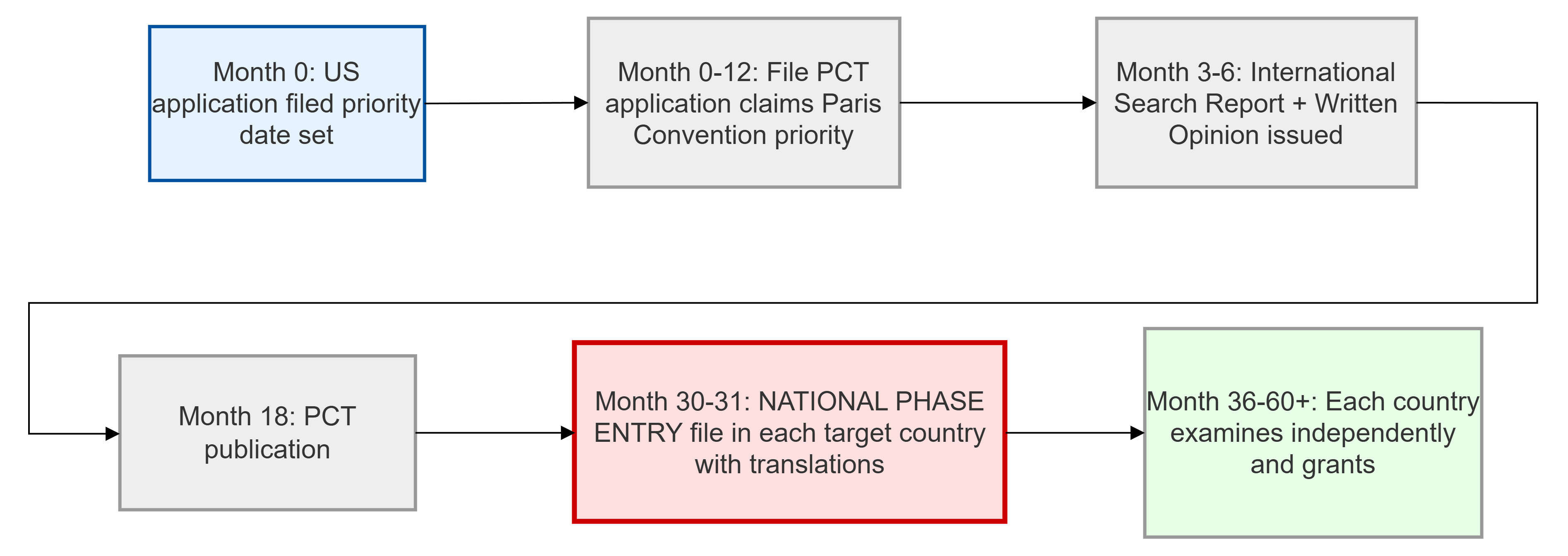
| Event | Months from Priority Date |
|---|---|
| US provisional or non-provisional filed | Month 0 |
| PCT application filed | Month 0-12 |
| International Search Report issued | Month 3-6 |
| PCT application published | Month 18 |
| Optional International Preliminary Examination | Month 6-28 |
| National phase entry deadline | Month 30-31 |
| National examination and grant | Month 36-60+ (varies by country) |
The total timeline from initial filing to granted patents in all target countries typically spans 4 to 7 years.
When International Protection Makes Sense
International patent filing makes strategic sense when:
You sell or plan to sell products internationally. If your revenue comes from or will come from foreign markets, protecting your invention in those markets prevents local competitors from copying you.
You manufacture overseas. Even if you sell primarily in the US, if your product is manufactured in China, Mexico, or another country, patent protection in the manufacturing country prevents unauthorized production at the source.
Your competitors are international. If your main competitors operate in specific countries, patent protection in those countries limits their ability to develop and sell competing products in their home markets.
The technology has high value and long commercial life. International patent costs are significant, so the technology must justify the investment. High-value inventions in energy, medical devices, oil and gas, and software and technology often meet this threshold.
You are seeking international partnerships or licensing. Patent protection in a partner’s or licensee’s country strengthens your negotiating position and gives the partner enforceable rights.
When to Skip International Filing
International protection is not always the right choice:
Your market is exclusively domestic. If your product is sold only in the US and you have no plans to expand internationally, a US patent may be sufficient.
The invention has a short commercial life. If the technology will be superseded within a few years, the cost of international filing may not be justified.
Budget constraints are severe. International filing costs can quickly reach tens of thousands of dollars. If those resources are better spent on US prosecution, product development, or market expansion, prioritize accordingly.
The invention is difficult to enforce internationally. Some inventions are difficult to detect and enforce in foreign jurisdictions. If you cannot realistically monitor and enforce your patent in a given country, the filing may not be worth the cost.
Working with International Counsel
International patent prosecution requires working with local patent agents or attorneys (called “associates” or “correspondents”) in each country. Your US patent attorney coordinates with these local counsel on your behalf, managing the overall strategy while the local agents handle country-specific requirements.
With extensive experience and a practice that includes international coordination for clients in oil and gas, energy technology, medical devices, and other fields, I work with a network of trusted international associates to manage the process efficiently.
Browse our Innovation Showcase to see examples of the types of technology that benefit from international patent protection.
Frequently Asked Questions
How long do I have to file an international patent application after my US filing? Under the Paris Convention, you have 12 months from your US filing date to file directly in foreign countries or to file a PCT application. The PCT then extends the deadline for entering specific countries to 30 months (31 in some countries) from your priority date.
Can I file an international patent if I have already publicly disclosed my invention? In most countries, any public disclosure before filing destroys patent rights. If you filed a US application before the disclosure, your foreign filings can claim priority from the US filing date, which predates the disclosure. This is why filing a US application (even a provisional) before any public disclosure is so important. See our provisional patent application guide for more on this strategy.
Do I need a patent in every country where I sell my product? No. Focus on countries that represent your largest markets, where competitors are most active, and where manufacturing occurs. Patent protection in three to five key countries is a common and cost-effective strategy.
What language does my international patent application need to be in? The PCT application can be filed in English. However, national phase applications must be translated into the official language of each country. Translation costs are a significant part of the total international filing budget.
Can I add new material to my international application that was not in my US filing? You can add new material to your PCT or national phase applications, but the new material will not benefit from your US priority date. Only the subject matter that was adequately described in the US application gets the early filing date. New material is dated from when it was first filed.
Disclaimer: All fees and cost estimates on this page are for informational purposes only and do not constitute a binding quote. Actual costs vary based on the complexity of the invention, USPTO fee schedules, exchange rates, and other factors. Contact Shannon Warren for a specific estimate tailored to your situation.
Considering international patent protection? Contact Shannon Warren to evaluate your options. With offices in Houston and Amarillo and experience coordinating international filings, I help Texas inventors make strategic decisions about protecting their technology in global markets.