
SYSTEM AND METHOD FOR UNWRAPPING ROUND MODULES
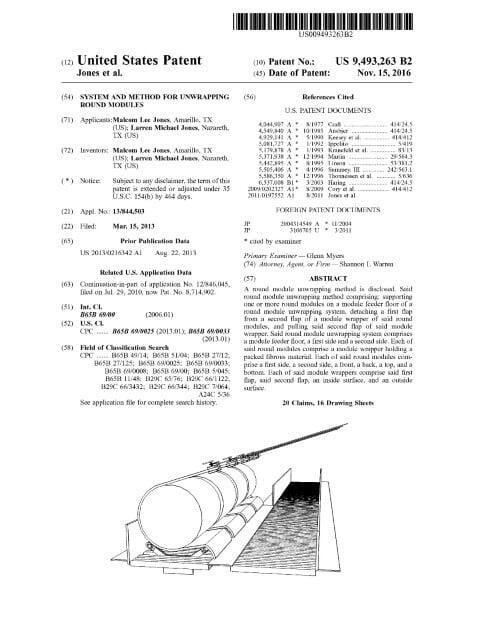
Patent Number: US 9493263 Grant Date: 2016-11-15 Filing Date: 2013-03-15
Overview
This patent describes a robust mechanical system and method for reliably unwrapping cylindrical, fibrous-product modules (exemplified by cotton) at high throughput. Filed on March 15, 2013 and granted on November 15, 2016, the claims cover an integrated arrangement of titling feeders, a longer primary feeder, and under-floor module rotators that lift, orient, and uniformly rotate round modules so flap attachments can be broken and wrappers removed without contaminating the product. Inventors based in Amarillo, TX and Nazareth, TX developed a coordinated pulling assembly that uses either clamps or a hook-and-loop clasp to engage an exposed flap, combined with controlled pulling forces and feeder tilting to roll the unpacked fibrous material onto the primary conveyor. The specification also protects key mechanical details such as accumulator-assisted pulley arms, belt-driven rotators, wind boards, and various clasping and line attachment options.
Key Features
- Conveyorized titling and primary feeders for controlled transfer and rolling
- Module rotators with accumulator-loaded actuating arms to lift and orient modules
- Flap-clasping pulling assembly (clamp or hook-and-loop) with line or hydraulic actuation
- Method claims covering alignment, flap detachment, pulling, tilting, and rolling
The drafting emphasizes practical, deployable mechanics for consistent, contaminant-free unwrapping, improving gin throughput and supporting broader automation in post-harvest processing and industrial material-handling.
Invention Details
Abstract: A round module unwrapping method is disclosed. Said round module unwrapping method comprising: supporting one or more round modules on a module feeder floor of a round module unwrapping system, detaching a first flap from a second flap of a module wrapper of said round modules, and pulling said second flap of said module wrapper. Said round module unwrapping system comprises a module feeder floor, a first side and a second side. Each of said round modules comprise a module wrapper holding a packed fibrous material. Each of said round modules comprise a first side, a second side, a front, a back, a top, and a bottom. Each of said module wrappers comprise said first flap, said second flap, an inside surface, and an outside surface.
Background: BACKGROUND (1) The applicants for these United States Letters Patent hereby claim the benefit of application Ser. No. 12/846,045, in which they are applicants and inventors as well. Further, said application (Ser. No. 12/846,045) is hereby incorporated by reference. (2) This disclosure relates to a system and method for unwrapping round modules. For purposes of this disclosure, cotton modules are discussed, and are an example of a fibrous material. However, such discussion of cotton modules is solely exemplary, and not limiting. (3) Methods for handling harvested cotton by cotton-harvesters, such as cotton strippers or cotton pickers, have evolved over the years. At one time, cotton would be dumped into trailers that were then delivered to the cotton gin. This system required frequent trips to the cotton gin, expending significant amounts of time and energy. Eventually, cotton strippers were developed capable of forming the cotton into rectangular cotton modules. Rectangular cotton modules eliminated the need for frequent trips to the cotton gin because modules were capable of accumulation without trailers. However, rectangular cotton modules were susceptible to damage due to environmental hazards such as moisture and wind erosion. To protect rectangular cotton modules awaiting delivery to a cotton gin, a plastic tarpaulin cover was frequently employed. Such methods of handling harvested cotton in covered rectangular cotton modules have been further improved by the introduction of cotton harvesters capable of making round modules of harvested cotton. (4) Round modules can be cylindrical packed cotton modules wrapped in tarpaulin covers along the side walls of the cylinder shape. They can be created of harvested cotton inside modern cotton harvesters. More comprehensively wrapped than their predecessors, round modules overcome many of the shortcomings of covered rectangular cotton modules. The round module can provide substantial savings by preventing lost or damaged cotton due to environmental deterioration. For example, round modules are less likely to absorb ground water which could foreseeably collect around the base of a cotton module. (5) Round modules represent a technological advancement in the handling of harvested cotton but cause new difficulty for cotton gins. Gin operators must completely separate cotton from the round module wrapper such that no contaminants from the wrapper remain during ginning. (6) Various methods exist for separating cotton from the round module wrapper. In one embodiment, a pair of curved arms lifts the round module and rotates the module along its cylindrical axis. A slitter for cutting the cover removes the cover during rotation. However, such system is incapable of accommodating multiple round modules simultaneously and fails to provide a uniform feed of unwrapped cotton exiting the system. In another embodiment, arm structures grasp, lift and reorient the round module into a vertical orientation, thereby allowing the weight of the cotton itself to pull the cotton out of the open bottom of the module. As the cotton drops from the module wrapper, the wrapper is retained by spikes in the grasping arm structures. Likewise, such system is also incapable of accommodating multiple round modules simultaneously and fails
Patent Document
Related: Agriculture | Mechanical Engineering | Robotics & Automation | Cotton Ginning | Packaging And Logistics | Robotics | Amarillo, Texas | Nazareth, Texas | Shannon Warren, Patent Attorney