
From Beautiful to Functional — Finding the Utility Patent Hidden in Your Design
Many inventors arrive at my desk with a product that is genuinely beautiful — a piece of furniture, a household tool, a fashion accessory, a kitchen gadget. They have spent months or years making it look right, getting the proportions, the materials, the finish exactly the way they imagined. They have shown it to family who love it. And they ask me the question every inventor asks: Can I get a utility patent on this?
The honest answer, more often than I would like, is probably not — at least not as drafted. Most beautiful inventions clear the bar for a design patent easily because their look is novel and ornamental. But to clear the higher bar of a utility patent, the invention must do something functionally that the prior art does not. And here is the catch: the inventor often has done something functionally novel, but it is buried under the aesthetic story they have been telling themselves and others. The functional invention is there. It just has not been articulated yet.
This article is the homework I give those inventors. It is a structured way to look at your beautiful invention and ask: did I solve a problem along the way? If the answer is yes — and we can describe that problem precisely — you may have a utility patent in addition to (or instead of) a design patent.
Why beautiful inventions usually qualify only for design patents
A utility patent protects how an invention works. A design patent protects how it looks. The two protections coexist comfortably for the same product — the famous example is the Apple iPhone, which carries both utility patents on its multi-touch software architecture and design patents on the ornamental shape of the device.
But the two patents are evaluated against fundamentally different standards. A design patent must be novel and ornamental. A utility patent must be novel, useful, and non-obvious. That “non-obvious” word is where most beautiful inventions get stuck.
The legal test for non-obviousness — codified at 35 U.S.C. § 103 and elaborated in KSR Int’l Co. v. Teleflex, Inc., 550 U.S. 398 (2007) — asks whether the invention, taken as a whole, would have been obvious to “a person having ordinary skill in the art” at the time of filing. If the examiner can point to existing products in the same field that suggest the combination of features you are claiming, your utility claim is dead.
Modular furniture, to take a category I see frequently, is old art. IKEA has sold modular tables, shelving, and seating systems since the 1970s. Lego-style stacking and recombining is not a new concept. So if your invention is “a modular table that the user can reconfigure into a chair, a bench, or a bar,” the examiner will reach for any of a thousand prior-art modular furniture references and say obvious. The aesthetic of your version may be lovely, but aesthetics by themselves do not move the utility-patent needle.
What does move the needle? A specific functional improvement that the prior art does not teach or suggest. Finding that improvement — articulating it precisely — is the homework.
The hidden utility patent — finding your “solved problem”
The framing I use with inventors is this: somewhere in the development of your beautiful invention, you encountered a problem. Maybe several problems. Things that did not work the first time. Things you had to redesign. Compromises you made to get the product into a stable, sellable form. Each of those problems is a candidate for the “solved problem” that anchors a utility patent.
The legal logic is simple. If you solved a specific technical problem, and the solution is not obvious from the prior art, then your solution is patentable. The aesthetic outcome is secondary; the functional outcome — the problem the solution makes go away — is the patentable subject matter.
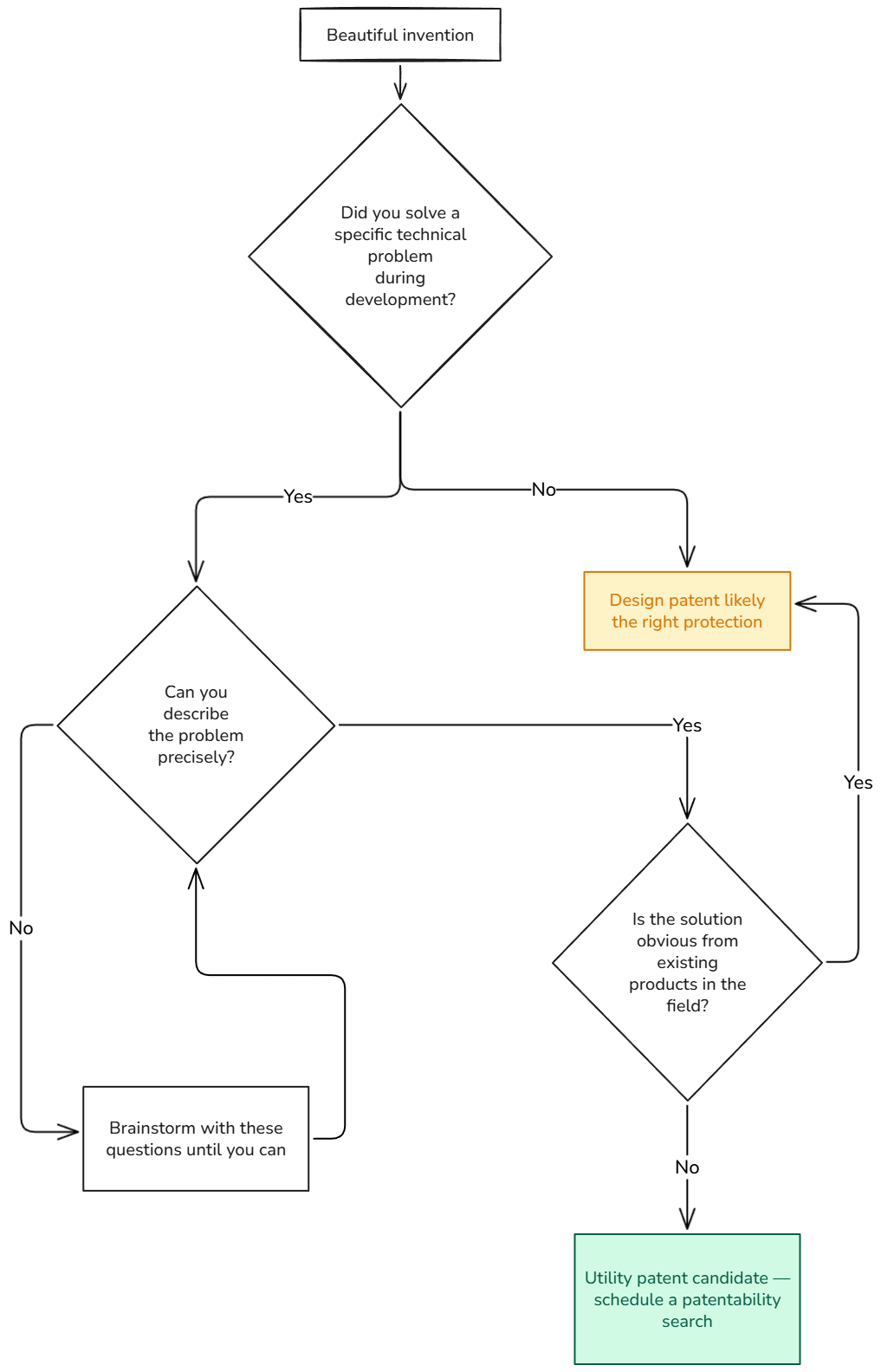
The hard part of this analysis is not the legal framework. It is recovering the memory of the problems you solved. Inventors are pattern-completers by nature — once a problem is solved, the solution feels obvious in hindsight, and the difficulty fades from memory. The brainstorm worksheet below is designed to recover those forgotten problems.
The brainstorm worksheet — questions to surface the functional invention
These are the questions I ask inventors during the initial consult. Sit with each one for a few minutes. Write down what comes to mind. If a question does not apply, skip it. The goal is not to fill in every answer — it is to find the one or two answers that point to a real functional improvement.
Question 1 — What did the first version of your invention look like, and why did you change it?
Almost every successful invention has a v1, a v2, a v3. Each transition between versions was driven by a problem with the prior version. Describe v1. Describe what failed about it. Describe what v2 changed to fix that failure. That fix is your candidate for a utility patent.
Question 2 — What materials did you try, and why did you reject the ones you rejected?
Material choice is one of the richest hunting grounds for hidden utility. Maybe you tried wood and the joints failed. Maybe you tried steel and it was too heavy to ship. Maybe you tried injection-molded plastic and the surface tolerance was unacceptable. Whatever material you settled on, you settled on it for a reason. The reason is often a functional improvement.
Question 3 — What is the smallest dimension or specification in your design that you would not change even slightly?
If you specified that a component must be exactly 2:1 in height-to-width ratio, or exactly 30 pounds, or exactly four fasteners per joint, ask yourself why that specific value? If the answer is “because it looks right” — that is design, not utility. If the answer is “because anything else fails structurally” or “because anything else is too heavy to move” — that is utility.
Question 4 — If a customer used your product wrong, what is the worst-case failure mode you designed against?
Safety considerations almost always involve hidden utility. Maybe you added a specific fastener pattern to prevent collapse. Maybe you specified rounded edges to prevent injury. Maybe you added drainage holes to prevent water accumulation. Each safety-driven design decision is a candidate for utility-patent claim language.
Question 5 — What did your beta users complain about, and what did you change in response?
Beta feedback is the inventor’s external memory. The complaints your early users surfaced were problems you may have forgotten you solved. “It was too heavy to move” → you reduced the weight per module. “It tipped over on uneven ground” → you added a self-leveling foot. “The pieces did not fit together precisely” → you added a registration tab. Each of these is potentially patentable.
Question 6 — What is the one piece of your design that you would patent if you could only patent one thing?
Sometimes inventors know intuitively which piece is the most defensible. They have just never been asked to isolate it. Ask yourself: if a competitor were going to copy your product, what is the one specific feature that, if they copied it, would feel like the worst betrayal? That feature is your strongest utility-patent candidate.
Where utility lurks: four common hiding places
When I review an inventor’s disclosure looking for hidden utility, I look in four specific places. If you are doing the brainstorm yourself, focus your attention here.
1. Material choices
The choice of material — concrete, GFRC, wood, polymer, metal alloy, fabric — is rarely arbitrary. Material constraints drive shape constraints, fastener constraints, dimensional constraints. A claim like “wherein the structural unit is fabricated from glass fiber reinforced concrete with a wall thickness of less than 12 millimeters and a maximum unit weight of 18 kilograms” is a real utility claim if the wall-thickness-and-weight specification solves a specific transport or structural problem that the prior art does not solve.
2. Fasteners and joinery
How parts connect is often where utility patents hide. Tongue-and-groove, snap fits, magnetic registration, captive fasteners, hidden mortise joints — each of these is a specific mechanical solution to the problem of holding components together under load. If your fastener design solves a real engineering problem (alignment under repeated assembly, resistance to vibration, accommodation of material thermal expansion), it is a utility-patent candidate.
3. Geometry tied to function
Pure shape is design-patent territory. But geometry that does something — a 2:1 ratio that enables specific stacking configurations, an angled face that channels water, a tapered edge that nests into another component — crosses into utility territory. The test is: does the geometry exist to look a certain way, or does the geometry exist to make something work?
4. Manufacturing or assembly methods
Sometimes the invention is not the product itself but how the product is made. A specific molding sequence, a specific curing protocol, a specific assembly jig — each of these can be patentable. Method patents are often overlooked by inventors but can be powerful for inventors who manufacture in volume.
When to stop looking
If you have worked through the brainstorm questions honestly and the answers all come back as variations of “it looks right” or “it is more elegant than the alternatives” — that is your answer. You have a beautiful invention that genuinely belongs in the design-patent bucket, not the utility-patent bucket. Filing a utility patent on aesthetics-only subject matter wastes money and produces narrow, hard-to-enforce claims that protect nothing.
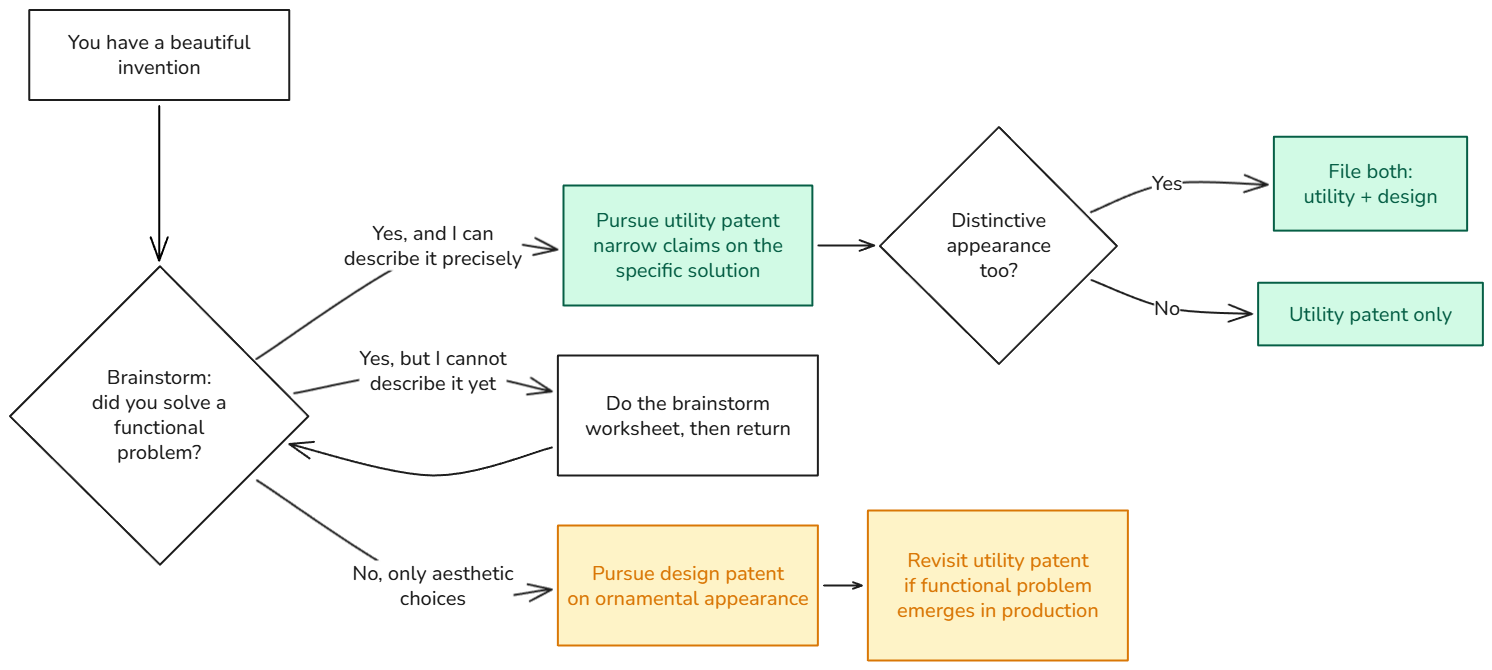
The honest counsel an inventor needs in this situation is: file the design patent quickly and well, build the business, and circle back to utility only if a real functional problem-and-solution emerges from manufacturing or use. Sometimes the utility invention surfaces a year into commercial production, when a real customer problem forces a real engineering change. That is the right time to revisit utility patent protection — when you have something concrete to claim.
The decision flow
Frequently Asked Questions
Do I have to choose between a design patent and a utility patent? No. The two protections coexist and many products benefit from both. The design patent protects the appearance; the utility patent protects the functional invention. Filing both is more expensive than filing one, but it provides layered protection that is much harder for a competitor to design around. See the comparison in Design Patent vs. Utility Patent for fees and timing.
What if my “solved problem” turns out to be obvious after a prior-art search? That is exactly what a patent search is for — to evaluate the obviousness question before you spend money on a full utility application. If the search reveals the solution is in the prior art, you save the utility application fee and proceed with design-patent protection only. The search is the protective step.
Can I file a provisional utility patent to “lock in” the date while I do the brainstorm homework? You can, but I do not usually recommend it. A provisional preserves a priority date only for the subject matter the provisional discloses. If the brainstorm later surfaces a functional solution that was not described in the provisional, the provisional does not protect it. A better approach is to do the brainstorm first, then file a provisional that actually describes the solved problem.
How long does the brainstorm take? Most inventors complete it in two or three sittings over a week or two. The first pass surfaces the obvious answers. The harder problems usually come back to you in the shower or while you are driving — something you had forgotten about will suddenly seem important. Give the process time.
What if I have a one-year-from-public-use deadline approaching? That is an entirely separate timing question. In the United States, you have one year from the date of your first public disclosure or commercial sale to file a patent application. If that one-year deadline is approaching and you have not done the brainstorm, prioritize the deadline. File a provisional that captures what you know, then continue the brainstorm and decide on the non-provisional within the 12-month conversion window.
Disclaimer: This article is for general informational purposes and does not constitute legal advice. Patent eligibility and claim scope depend on the specific facts of each invention and the prior art at the time of filing. Contact Shannon Warren for a consultation tailored to your situation.
Have a beautiful invention and want help finding the utility patent hidden inside it? Contact Shannon Warren for a consultation. I will walk through the brainstorm questions with you and give you an honest read on whether utility protection is a realistic option — or whether design-patent coverage is the better path. Either way, you will leave the conversation knowing what you are working with.